MIRAS International Schools and Kindergartens
NNEF operates three MIRAS kindergartens in Astana, Almaty, and Atyrau. Each combines the Kazakh state standard with International Baccalaureate (IB) Primary Years Programme (PYP) principles and Montessori pedagogy. Individualised learning, social‑emotional development, and active parental involvement are core features, ensuring children build strong foundations from an early age.
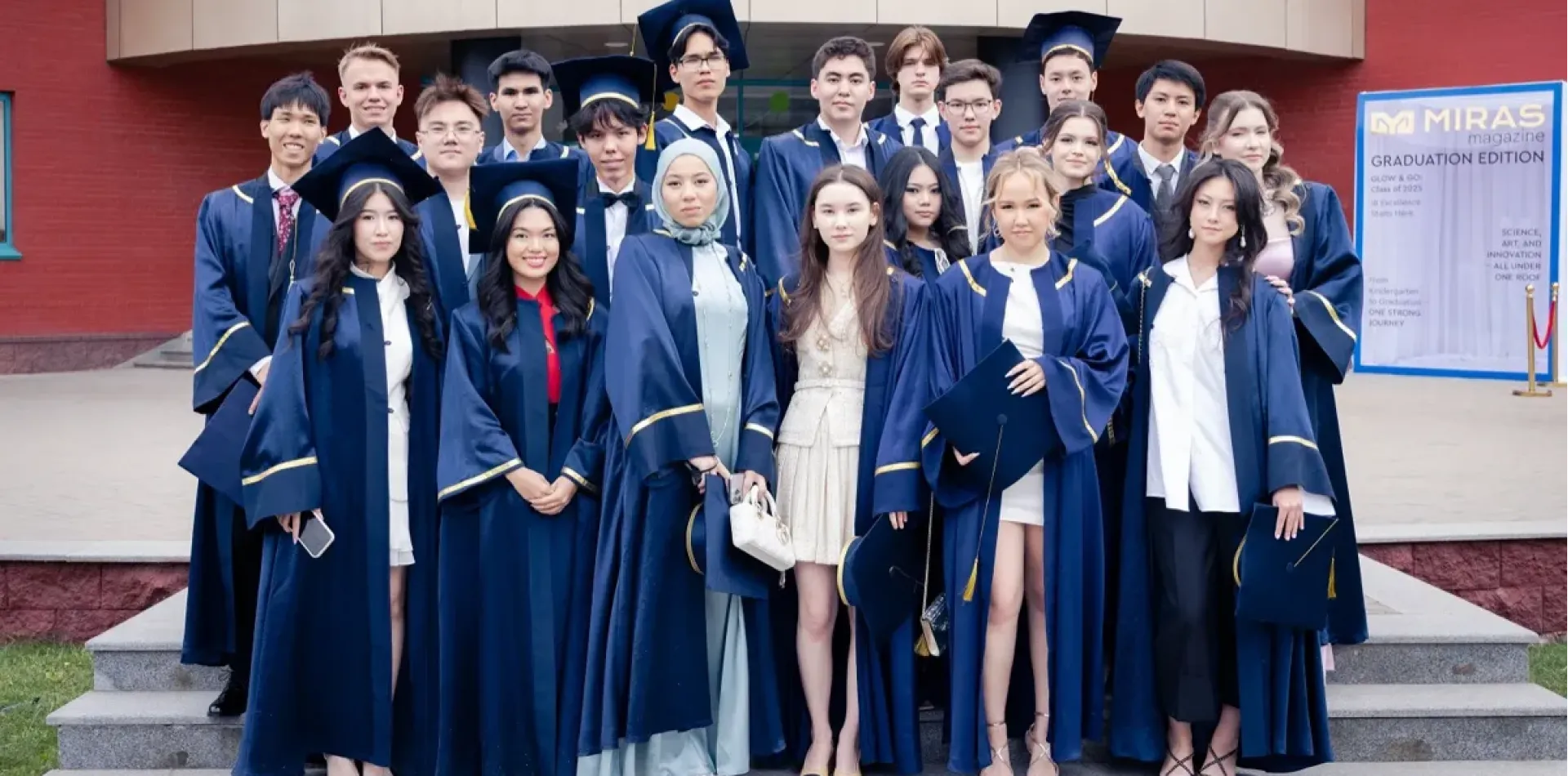
NNEF’s MIRAS Schools in Astana and Almaty, alongside the International School of Almaty, bring together Kazakhstani and international educational standards. MIRAS Schools are authorised across three IB programmes and accredited by the Council of International Schools. This places them among a small number of globally recognised institutions in the country.
Students consistently achieve strong results in international Olympiads and academic competitions, and these achievements translate directly into strong university pathways. The schools’ commitment to project‑based learning, criterion‑based assessment, and digital learning environments equips students with the analytical, creative, and research skills needed to thrive not only at school but also in higher education – both in Kazakhstan and abroad.
MIRAS graduates secure strong results in the IB Diploma Programme (IBDP), performing at a level aligned with global standards. According to global IB statistics, only around 8% of IBDP graduates worldwide score 40 points or more out of 45, and students from MIRAS are consistently among this high-achieving group. These outstanding academic results open the door to admission to leading universities around the world, where MIRAS graduates often receive scholarships and tuition discounts.
Higher Education
NNEF co-owns and supports several of Kazakhstan’s leading universities, including the International Information Technology University (IITU), Astana IT University (AITU), Kazakh-British Technical University (KBTU), and Gumarbek Daukeyev Energo University (AUES).
Demonstrating strategic foresight and an ability to anticipate future trends, Dinara Kulibayeva was among the first to champion specialised IT education in Kazakhstan. With her support, the IITU was established as the country’s first international IT university, followed by the launch of Astana IT University in the capital – a major step in strengthening Kazakhstan’s modern digital and technological education ecosystem.
NNEF-affiliated universities are at the forefront of Kazakhstan’s higher education transformation, combining strong academic foundations with a clear focus on digital innovation. They offer modern academic programmes, maintain high graduate employability, and hold strong positions in national, and international rankings. The Foundation’s universities and their academic programmes have also been recognised through accreditations and quality assurance reviews conducted by respected organisations such as ASIIN, ABET, IAAR, IQAA, and FIBAA, reflecting a strong commitment to academic quality and international standards.
The international reach of these institutions is further reflected in their double-degree programmes and academic mobility partnerships with leading universities in Europe, the United States, and Asia including the London School of Economics, Adam Mickiewicz University, and China University of Petroleum, giving students access to world-class education, international research environments and broader career opportunities.
In 2021, NNEF supported the creation of the University Alliance, a collaborative platform that brings together six universities – IITU, AITU, KBTU, AUES, University of International Business, and East Kazakhstan Technical University – to advance interdisciplinary education, scientific collaboration, digital innovation, and international academic mobility.
These institutions are among the leaders in integrating artificial intelligence across their curricula. They embed AI, data science, and digital engineering into teaching and research, helping students develop the knowledge and practical skills needed to succeed in the digital economy and innovation-driven industries. They were among the first in Kazakhstan to introduce degree programmes in artificial intelligence at both bachelor’s and master’s levels. They also run the Summer AI School for academic staff and systematically prepare university educators capable of teaching AI-related disciplines to a high professional standard.
Investing in Kazakhstan’s Future
Over the past two decades, these schools and universities have become a recognised model of modern education in Kazakhstan, combining innovation in teaching with a strong commitment to developing well-rounded, socially responsible young people. They continue to shape the future of Kazakhstan’s youth, reflecting Dinara Kulibayeva’s belief that education is the most powerful investment a society can make.
This commitment is also reflected in the Foundation’s scholarship programme for talented young people seeking to study at MIRAS International Schools. Over six years, the programme has involved more than 2,000 high school students from different regions of Kazakhstan; more than 80 scholarships have been awarded, including 28 with full tuition coverage.
Since 2021, more than 500 staff members from the NNEF have taken part in the Foundation’s annual professional competition, Teacher of the Year, which recognises teaching excellence, creativity and innovation across the NNEF educational community. In 2025 alone, the competition brought together more than 100 participants and was officially recognised as part of Kazakhstan’s professional teacher competitions. Winners receive monetary prizes, further reinforcing the Foundation’s commitment to supporting and celebrating outstanding educators.
The Foundation also actively shares its educational experience by creating platforms for professional exchange and organizing seminars, training sessions, and conferences. Through its schools and nursery-kindergartens, it has delivered more than 60 events of different formats – including international IB conferences, national and international scientific and practical conferences, and professional seminars for educators and school leaders – while continuing to promote dialogue and innovation through major initiatives such as IT FEST and EDU FEST.



 English
  Kazakh
  Russian